
For those who are lurkers, artists (and feeling artists), creative (and feeling creative), new startup founders, service providers, crazy ones, rockstars (and wannabe rockstars), confused, lazy to set personal goals, hate new year’s resolutions, rich and not famous, cool professors, afraid to start a new beginning, newly grads, about to get married but no job yet, and stalkers, this roadmap is blogged especially for you.
I have yet to share some of the best things happened to me in 2011. My yearend blog doesn’t say about them. It’s more about a mix of appreciation and gratitude despite a very few uninspired stupefaction.
You might have read my 2010 yearend blog,“Get Wired. Leapfrog. Discard The Crap. Make It Happen in 2011”. And I commend that “it did happen” in 2011. You may end up with the same intuition I had 2 years ago. It may answer some of the questions in your today’s business or personal life.
When I finished reading the book Enchantment by Guy Kawasaki, I was surprised it says about what I uniquely encountered and how I managed to handle the different eccentricities last year. My tweet says, if you’re an entrepreneur, you should start reading the last chapters. Then, go read the beginning afterwards. Through here I confirmed that I made positive decisions in the previous year.
The first thing I did on the very first day of 2012 is to attend the Sunday worship service. As I listened about the meaning of the word “blessed” being preached with its “what”, “how” and “who”, it teaches on how to set a boundary between you and a situation. Thus, you can enchant even if you don’t compromise if you really know the state of happiness and its Source.
I spoke to 3 different people in the last 2 weeks. I never asked about their insight on what will take ahead to different classes of people (particularly Filipinos) as far as the real estate market is concerned. Incidentally, 2 people said almost the same thing that it is easier to sell a property to a low-budget buyer and a high-end prospect, and it’s difficult to sell to the middle-class market. The low-end buyer will settle for what they can afford to immediately own one. The high-end will look for more sophistication of which not all of the developers can provide. But once delighted, convincing them to buy is not a problem. The middle-class will contemplate and usually ends up buying nothing or indecisive. The 3rd person, if I may link, says the poor will become poorer and the rich will become richer. In a nutshell, it explains that the middle class will either advance or regress. Then everything connects to what I wanted to blog and share on this topic.
Looking ahead and ask how will you position yourself in 2012? How did you prepare yourself in 2011 so you can catch up in the coming years?
Since we live in this world with many options, it’s both easy and difficult to start, to manage, and to sustain what you’re into. You will need to figure out how to keep that same discipline that must apply to you. More importantly is how you compose and introduce yourself to the public. Regardless if you’re introvert or extrovert, it doesn’t matter. Make up how you want to be labeled. It plays an essential role in your life.
What I am sharing is not about how to make New Year’s resolutions (I don’t really advise you doing it). Neither it is setting up goals for the year since not all of us are in the same status in life. I may have different views in this. What I would like to impart is a roadmap that will guide you either prepare or change for the better you.
If you haven’t started doing it in the last quarter of the previous year, you better start thinking. Begin asking yourself how would you like to be labeled as what? How will you impress others without releasing false advertising? How will you hold on to succeed without deceiving?
Know Personal Branding
If you’re a sound and lights/technical supplier,
• Dress accordingly most especially during the post mortem meeting with corporate clients. It shows respect. Impress your clients that you’re a professional even if you work in a technical-oriented environment. Make yourself different from your crew. Speak comprehensibly. Don’t talk too much technical. Not everyone can understand you. Not all people are tech-savvy.
If you’re a restaurant/bar/club owner,
• Announce it. Make noise about the latest in your menu. Twit about your chef’s best and highly recommended entrees. Do what Ivan Zalameda of Draft and Opus does like posting on his Twitter their opulent dishes. It makes his followers crave, come and dine-in. Anyone can hire the same good DJs but not all can serve the best and sumptuous food.
If you work in a PR company,
• It’s not yet too late to create a Twitter account and utilize it. Since I joined Twitter on March 26, 2007 (check whendidyoujointwitter.com), I haven’t seen it as powerful as it was last year. Different smartphone brands like HTC, Netphone 701, Nokia N9, iPhone 4S, etc. with client Smart Communications have successfully exploited Twitter advantages. I want to give credit to Jon Herrera (a.k.a. Johnny Verse) for this.
If you’re an IT/Web company owner or professional,
• Be articulate. You don’t need to prove that you’re a geek. It says already through the nature of your job or by looking at your business card. Connect more to the real world. The most innovative company knows what the consumers want and I guess you also desire to own an iPad, iPhone or a MacBook Air.
• Dress and act like a real entrepreneur, if you’re one. At the end of the day, it’s all about a business impression. It’s not just about your skills. It’s more about the personal representation. What you represent will also mirror your company’s culture. Remember that when Steve Jobs was on stage and talked, it personified the whole Apple environment.
If you’re an educator,
• Don’t be too stiff. Try to be cool at once (at least in the undergraduate schools). Mingle. Experience parties and events just to see what’s in the outside world. Be a savoir faire. Use social media to share your knowledge. Your Linkedin account should say something about the real you. Listen to business people, practitioners, and industrialists. Try to talk to a member of a rock band and you can pick up some creative ideas. If you need a second opinion, ask Paul Pajo (a.k.a. Pageman). And if you don’t agree with me, don’t be prejudiced. Sometimes you have to listen to stupid ideas. It’s called Dopeler effect, that is the propensity of stupid ideas to seem smarter when they swiftly come at you.
If you’re a creative professional,
• Don’t announce that you’re burned out with your job. Your colleagues and co-workers probably know about it already.
• Reinvent. Be more creative. Go out of your personal cubicle. You bring ideas out-of-the box and integrate them to what is given. Most of the time you just copy. And you won’t admit it. But please refresh your mind and be open-minded. Don’t settle with the existing system that doesn’t work. Outgrow what you believe in if you’re not helping the company financially. You may listen to other people’s ideas but give them the credit.
Learn The S-Curve
I guess 10 years is not yet too late to commend and thank my professors in University of the Philippines Technology Management Center especially Edison Cruz, Dr. Serafin Talisayon, Dr. Jose Magpantay, and Dra. Elvira Zamora (who was seemed surprised when I came up on stage to receive my award/certificate as a University Scholar). All of them shared the best from different disciplines to course us to a degree in Master of Technology Management (MTM). It’s where I assimilated the various applications of The S-Curve.
Let me educate you first about The S-Curve and why it can also be applied in our lives.
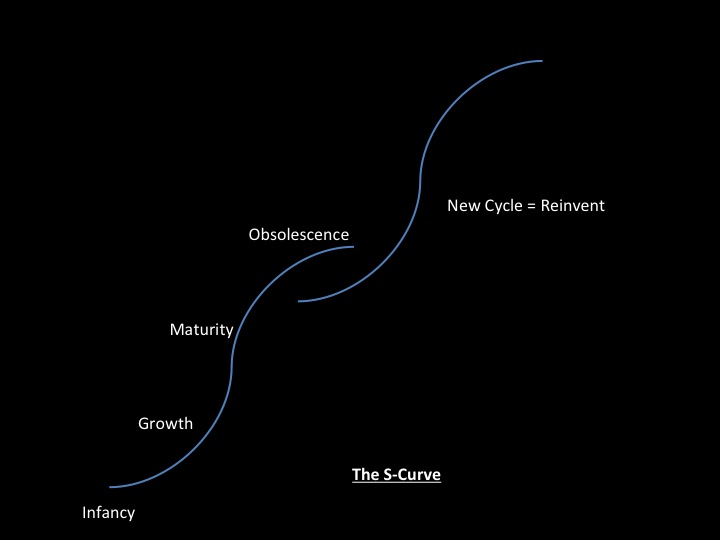
Learning The S-Curve Cycle is simple. By looking at the figure, you will already think that technology life cycle is easy to understand. The question is despite considering the S-Curve, why many companies still fail? Why not all products succeed? The S-Curve doesn’t only apply to technology. It may also apply to your business and career. Try using it in your own personal planning. It will absolutely work.
When I was managing Livewire Productions and Sonorous Professional Sound and Lights in the late 90s, I thought I needed to go to a graduate school but in 2 conditions. First condition, MBA is very common. Thus, it’s not absolutely my choice. Financial analysis turns into financial paralysis when you deal with delinquent accounts even though you’re loaded with MBA financial theories. I wanted a course that will connect technology to business and vice-versa. Second condition, University of the Philippines-Diliman is my only choice next to Stanford University.
Bingo! I found a course that tackles the integration of business and technology. It’s where I learned the importance of social science and helped me boggled my mind with technology forecasting and assessment. Product development and marketing are parts of one of my favorite subjects, Managing Product and Process Innovation. I learned the Financial Management in a smart way. I became more interested in Silicon Valley, Palo Alto Research Center, and Wall Street.
After 10 years since I studied about the connection of social to business and technology from MTM, Steve Jobs confirmed what I learned when he said, “Technology alone is not enough. It’s technology married with liberal arts, married with humanities, that yields the results that make our hearts sing”. It also confirmed that I haven’t gone wrong with the graduate course I took up and finished.
Technology is not just a hardware or software as many thought. Technology is a discipline or principle. It’s like embracing a Zen inspiration. It doesn’t really speak about technical matters. It’s more about business and innovation regardless of the type of industry.
Without the knowledge of The S-Curve yet, the call to give birth to a new cycle is needed. The same knowledge, typical experience and common business problems won’t help you grow enough without profoundly comprehending and acting upon them. In other words, the maturity stage will come. And you need to reinvent to form a new cycle.
Nokia started as a pulp and paper company. Launched the first fancy mobile phones. Once a global leader in the mobile industry that enjoyed the long period of growth and maturity, Nokia might have not anticipated the coming of smartphones. Nokia didn’t immediately reinvent and innovate until it taps the obsolescence stage. It has been outstripped by iPhone, Blackberry and Android-powered phones.
There is a time that you will feel so relax that you wouldn’t want to get out of your comfort zone. Everything is just ok. Money may not be a problem. Business is doing just fine. You settle with your bosses’ complacency in your job. There is also a time that you will feel you have to work harder because of financial needs. Your career may be disoriented. Perhaps you’re a victim of a scam.
Either you bootstrap a new group, start a new career, managing a business along the way, finding yourself lost in a world of reality, getting burned out, or too excited about your new passion, it’s just a repetitive cycle of inventing and reinventing.
Try to imagine yourself as a company and that your knowledge and skills as your product. Exercise and make them grow. Before the maturity comes, observe your surroundings. The competition will never disappear so always be aware of your strengths and weaknesses. Take advantage of the opportunities that will come to you. Before the maturity stage, you should already be thinking of what and where to invest next. Last year, I personally positioned myself in what I believe a very good investment. It will measure and determine the favor in the next 4 years. I’m considering it as the beginning of my next S-Curve. Do not let yourself reach the obsolescence stage (maybe a personal synonym of burn-out, stressed, retirement, useless, e.g.) in your life.
Twelve months of 2012 is too short for this cycle. But at least you already have a roadmap. You may be in between those stages (infancy, growth, maturity, and obsolescence). You may be just starting up. But the chance to repeat another cycle in your life, career, and business is already given. Understand which stage you are in the curve. Excite yourself! If you think or feel you’re already in the maturity-obsolescence period, reinvent yourself to create a new life cycle.
 RONALD LUCERO
your insight is like a freshly squeeze orange – packed with goodness! thx bro!
Great post. Thanks for sharing the beauty of the S-Curve which represents the very meaning of Technology Management.
Yeah, I’m prttey much on the record with my opinions. But that’s okay, the exit strategy doesn’t include needing the approval of too many people. The few that are needed well understand where I’m coming from.